
Best Pet Turf for Dogs: A Puget Sound Buyer's Guide. (Copy)
Mud Season Lasts 9 Months Here. How to Choose the Best Pet Turf for Dogs in Puget Sound.
There's a trail along your fence line. Bare dirt about eight inches wide, worn down by the same dog running the same loop every day. There's a second bare patch at the back door and a towel on the floor next to it that's been there since October.
You've reseeded, maybe twice. It comes in thin and it's gone by November.
Here's the short answer. The best pet turf for dogs is turf engineered for dogs from the start: a fully permeable backing, no infill, and short dense blades.
What matters just as much is what goes underneath it: a compacted rock base that gives water somewhere to go. Most products sold as pet turf are landscape turf marketed to pet owners after the fact, and in a Puget Sound winter that difference shows up fast.
Your lawn isn't dying because you're doing it wrong. It's dying because a dog and 150 days of rain are a combination natural grass can't survive.
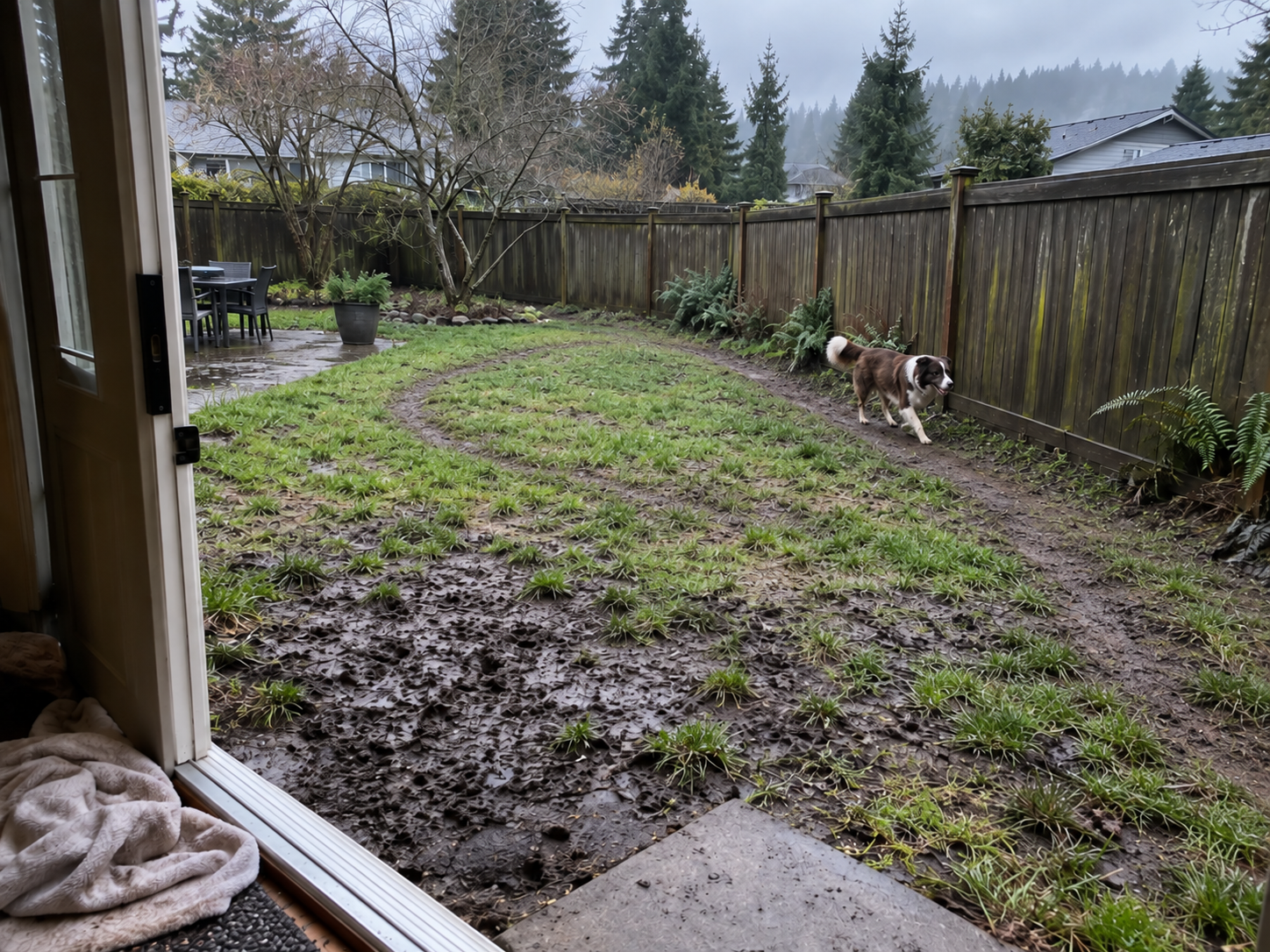
Caption: A typical starting point. The fence-line trail and back-door bare patch that show up in almost every dog yard we assess.
Why natural grass fails in a Puget Sound dog yard
Two things work against you at the same time.
The first is what sits under your topsoil. Much of the Puget Sound lowland sits on dense glacial till, soil compacted by ice sheets into something closer to hardpan than dirt.
Rain hits it and stops. It doesn't percolate down. It sits in the top few inches and waits to evaporate, which in this climate takes until roughly June.
The second is your dog. Every trip along the fence compresses the soil a little more, and compacted soil holds even less air and water.
Roots can't establish. The areas your dog uses most become the areas where grass has the least chance. Add mature firs or cedars anywhere near the yard and you have real shade on top of it. Grass never gets enough light to recover from the traffic it took that week.
Seed can't win that. It was never a fair fight.
What homeowners try before pet turf, and why each one fails
Most people arrive at pet turf after two or three other attempts. Every one of them is a reasonable instinct. Here's where each breaks down.
| Option | Upfront cost | Why it fails in a dog yard | How long it lasts |
|---|---|---|---|
| Reseeding | Low | New seed lands on the same compacted, saturated soil and fails the same way | Usually one winter |
| Bark or wood chips | Low | Holds water, breaks down into dark sludge that tracks indoors, and dogs eat it | Two to three years |
| Pea gravel | Moderate | Hard on joints, migrates everywhere, waste is nearly impossible to pick out, urine soaks into what's underneath | Indefinite, but unpleasant |
| Drain rock or a French drain alone | Moderate to high | Solves the water, leaves a surface no dog wants to lie down on | Long |
Each of these treats a symptom. None of them addresses both problems at once.
It was never a grass problem. It's a turf drainage and weather problem wearing a grass problem's clothes.
Once you see it that way, the question stops being "what should I plant" and becomes "where does the water go, and what surface sits on top." That reframe is the difference between a pet turf lawn that works for fifteen years and one that turns into a smelly puddle in year three.
What separates the best pet turf for dogs from landscape turf
Not all synthetic grass is built for dogs. Most of what gets sold as pet turf is landscape turf marketed to pet owners after the fact, and the difference becomes obvious in about eight months.
| Feature | Landscape turf sold as pet turf | Turf built for dogs (K9Grass) |
|---|---|---|
| Backing | Solid, with drain holes punched through at intervals | Knitted and permeable edge to edge |
| Drainage path | Liquid travels sideways to find a hole | Straight through, anywhere on the surface |
| Infill | Sand or rubber crumb | None |
| Blade length | Long, chosen for photographs | Short and dense |
| Odor control | None, or a surface spray | AlphaSan antimicrobial embedded in the blade |
The backing. On standard landscape turf, dog urine has to travel sideways across a solid backing to reach a punched hole. What doesn't make it there dries on the plastic, and that's where the smell starts.
K9Grass uses a proprietary knitted Flow-Through Backing that is permeable edge to edge, so liquid passes straight through wherever it lands.
No infill. Most turf needs sand or rubber crumb to hold the blades upright. That infill is exactly where pet waste and odor collect, and it's what your dog is chewing when he comes up with something black in his mouth.
K9Grass doesn't use any. Nothing to trap urine, nothing to swallow.
Short, dense blades. Long blades photograph well and perform badly. Solid waste sinks down into them and sticks.
Short dense blades keep waste sitting on top, where you can actually find it at 6 AM in the dark in January.
Antimicrobial in the blade. AlphaSan antimicrobial is found only in K9Grass, and it's built into the blade itself rather than sprayed onto the surface. It doesn't wash off in a climate that rains 150 days a year. It fights bacteria and reduces odor.
You can see the full product detail on our K9Grass page.
How pet turf drainage actually works: the base under the grass
This is the part that separates a good installation from a cheap one, and it's the part you can't see once the job is done. Once you've chosen a product, what goes underneath it decides whether it survives our winters.
We excavate, then build a base of 5/8-inch minus crushed rock compacted to 95% at a depth of three to four inches.
Angular crushed rock locks together under compaction. It stays put and stays permeable instead of settling into ruts. The turf goes over that, so water passing through the backing has somewhere to go immediately.
That base does two jobs. It moves standing water off the surface where your dog is standing, and because it's angular rock rather than soil, it doesn't compress into a mud layer under traffic the way your lawn did.
The practical result is a surface that stays usable in the rain instead of drying out sometime late in the afternoon.
Caption: The 5/8-inch minus base, compacted, before any turf goes down. This is where a cheaper bid usually saves its money.
Six questions to ask before you sign a pet turf quote
You'll probably get more than one bid, and they won't be the same number. The gap is almost always in things you can't see. Ask every installer:
What base material, and how deep? You want a specific answer with a number. Ours is 5/8-inch minus crushed rock at three to four inches, compacted to 95%. Ask how that compares.
How is the turf secured at the edges and seams? Nails, staples, or spikes, and what are they made of? Galvanized fasteners rust in this climate. Seams held only by glue come apart under a dog who digs. We use glue plus a patented micromechanical seam tape.
Is the backing permeable edge to edge, or perforated with drain holes? This is the single biggest driver of whether odor develops, and it's easy to check before you buy.
Does the product use infill? If yes, ask what happens to the waste that settles into it, and who removes it.
What does the warranty cover, and who comes back out? The product warranty covers the turf, not the installation, and a seam or edge that fails two years in is an installation problem. Ask whoever you hire to say plainly that they'll return and fix their own work. Ask us the same thing.
Where was it made, and who is doing the installing? K9Grass is made in the USA. Our foremen average five years of installation experience, and our crews are our own employees rather than subcontracted labor.
If a bid comes in significantly cheaper, one of those six is where the money came out. That isn't always the wrong trade. But you should know which one you're making.
Our FAQ page answers several of these in more detail.
What pet turf costs, and what installation is really like
It costs real money. As of 2026, a residential K9Grass yard around 500 square feet generally runs $7,000 to $8,500 turnkey. Flexible payment is available through financing.
It's construction, not carpet. We excavate, haul material out, and bring rock in to compact. Your yard will be torn up and there will be equipment in it for a few days. We haul our debris out when we go.
Maintenance drops close to zero, but not to zero. You still pick up solid waste and rinse the surface periodically. In heavy-use areas you'll rinse more often in the first month than you will later, once you learn how little it needs. Our maintenance guidance covers the routine.
Two Puget Sound pet turf projects you can go see
Friendly Grove Resort & Spa for Dogs, Olympia. A client across multiple projects over several years. We've now installed every dog area on their property.
They came back phase after phase, after living with the earlier ones through full Olympia winters under commercial traffic. That's a harder endorsement to earn than a testimonial.
Hounds Hollow Dog Park, Bonney Lake. The opposite test. About 9,900 square feet of our turf, open to the public thirteen hours a day, unlimited unsupervised dogs, year-round, with nobody maintaining it the way a professional facility would.
It's public. You can drive out this weekend and stand on it before you spend a dollar.
Caption: Commercial traffic, year-round, in Olympia rain. The hardest test we can point you at.
Choosing the best pet turf for dogs in your yard
You don't have to decide anything today.
If you're weighing options for a dog yard that's already gone for the winter, we can walk your space with you, look at how water actually moves through it, and tell you what a proper base would take. No cost, and no obligation to buy anything.
Request a consultation, or go stand on the turf at Hounds Hollow first. We'd rather you did.
